Everyday women's dresses: how to choose
Everyday women's dresses are clothes that feel comfortable at work, around town and on the road. To keep a dress from sitting unworn in your wardrobe, choose it by three parameters: length, cut and a fabric suited to the season. Length determines which shoes and outerwear you will wear it with, cut determines how it sits on your figure, and fabric determines whether you will be comfortable in the heat or the cold. It is worth thinking through all three points before you buy a dress.
Which length to choose: midi, knee-length, mini or maxi
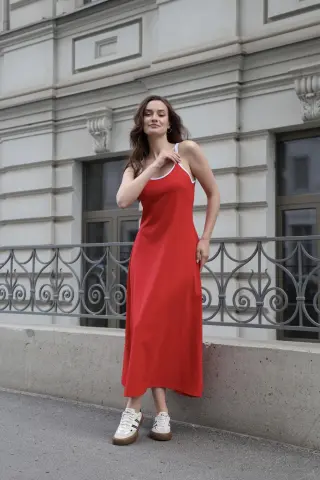
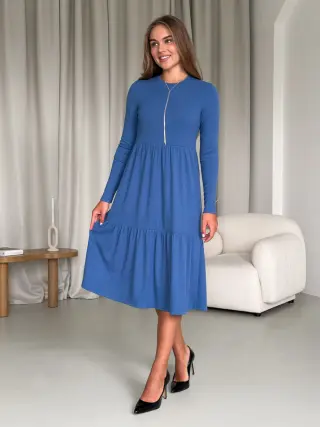
A midi dress is the most versatile option for an everyday wardrobe. It covers the knees, looks good with sneakers, ballet flats and boots, and does not hinder walking if it has a slit or a loose hem. Shorter women should try on a midi that ends slightly below the knee: a mid-calf length visually shortens the legs if the shoes have no heels.
Knee-length and mini dresses are for those who like bare legs and an active daily rhythm. A long-sleeved mini looks great in autumn with thick tights and chunky boots. An everyday maxi is most often made of knit fabric: an ankle-length tank dress or T-shirt dress replaces trousers in summer and pairs easily with sandals.
Pay attention to slits. In long fitted styles, a slit is needed for comfort, not just for looks: without it your stride is restricted. For example, Merlini Casso and Merlini Condo have a side slit, while Merlini Grado and Merlini Veneto have one at the back. A side slit is more noticeable and shows the leg as you walk, while a back slit is more restrained and more appropriate in an office.
Cut for your figure and lifestyle
A straight dress and a T-shirt dress are a base that is easy to change with accessories: with a blazer you get a work look, with a denim jacket a look for a walk. An A-line dress widens toward the hem and hides the stomach and hips without clinging to them. A wrap dress defines the waist and creates a V-neckline, so it is often chosen by women with fuller figures: the depth of the wrap can be adjusted to the bust, and the belt to the waist.
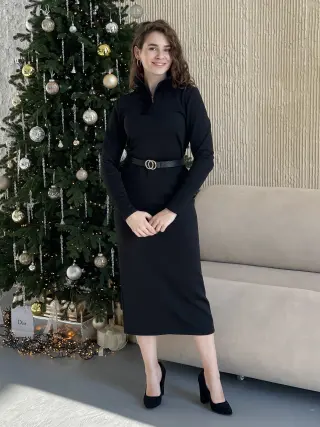
A polo dress and a dress with a collar look neater than a T-shirt and suit occasions when you need a restrained but not business-like look. A turtleneck dress with a high neck keeps your neck warm and replaces a sweater and skirt combination. A hoodie dress with a hood is the sportiest option: it is worn with sneakers, a puffer jacket and warm hats.
If you wear plus sizes, do not automatically choose the widest cut: an overly voluminous dress adds visual weight. Wrap styles, belted dresses or an A-line with a defined shoulder line work better. Stretchy ribbed knit hugs the figure, so if you do not want to emphasize your shape, look at a loose cut or denser fabrics.
Fabric for the season
A summer dress should let air through and not cling to the body. Viscose (staple) is a light fabric, soft and cool to the touch; floral-print dresses are often made from it. Linen copes with heat best, but it wrinkles — that is its natural property, not a flaw. Muslin is thin cotton in several layers, used for light sundresses such as Intruder Lilo.
Ribbed knit is an all-season option. Merlini ribbed fabric is stated to be 70% cotton and 30% elastane: cotton gives a pleasant feel, elastane gives stretch and keeps the shape. With short sleeves or sleeveless, such a dress is for summer; with long sleeves, for spring and autumn, and on cooler days it is complemented by a jacket or vest.
A warm winter dress is above all fleece-lined knitwear: smooth on the outside with a soft pile inside. It keeps you warm without an extra sweater, so thick tights are enough under it. Angora and cashmere are softer and more delicate, but more demanding to care for. Velour and fur-lined knit suit those who spend a lot of time outdoors.
| Season | Fabrics | What to consider |
|---|---|---|
| Summer | Viscose, linen, muslin, ribbed knit | Short sleeves or sleeveless, light colors |
| Demi-season | Ribbed knit, knitwear | Long sleeves, collar or high neck |
| Winter | Fleece-lined knit, angora, cashmere | Density, length below the knee |
How to pick a size and care for your dress
Sizes of knit dresses are often double — S/M, L/XL, 2XL/3XL, 4XL/5XL: stretchy fabric fits two adjacent sizes well. If you are between two sizes in a fitted ribbed model, take the larger one so the dress does not pull across the hips. Check the length against your height: the same model will be a midi on a tall woman and almost a maxi on a shorter one.
Wash knitwear inside out on a gentle cycle and dry it flat so it does not stretch. Do not dry fleece dresses on a radiator — the pile mats and stops keeping you warm. Viscose and linen can shrink in hot water, so read the label before the first wash. Wash angora and cashmere by hand or on a wool cycle.
A dress easily becomes the basis of an outfit, and you can pick the rest of your items in the women's clothing category. If you want more options for work, browse women's suits and shirts and blouses, and for summer — T-shirts and tops.
Frequently asked questions
Which dress is suitable for every day?
The most practical is a midi dress in ribbed knit or viscose. It does not restrict movement, is easy to iron or does not need it at all, and goes with different shoes. Choose the cut by your usual rhythm: a T-shirt or polo dress for the city, a wrap dress when you want to emphasize the waist.
Dress or "платье" — which is correct?
In Ukrainian, both "сукня" and "плаття" are correct — they are synonyms. "Платье" is the Russian form, which is often typed into search, but it refers to the same garment. In model names, "сукня" is usually used.
What to wear under a warm dress in winter?
Under a fleece-lined dress, thick tights are enough, and in severe frost, thin thermal underwear. A length below the knee together with high boots protects your legs from the wind. On top, a puffer jacket or a long jacket that fully covers the hem will work.
Is a ribbed dress see-through?
Dense ribbed knit is usually not see-through: for Merlini ribbed fabric this is stated directly in the descriptions. In white and light dresses, it is still better to wear nude-colored underwear. Check thin knitwear against the light when trying it on.
How much does a women's dress cost?
Dress prices range from 349 to 1 699 UAH. The cost depends on the fabric and cut: cashmere, angora or fleece-lined models usually cost more than summer ones in cotton or viscose. Complex styles with a wrap, collar or zipper also affect the price.